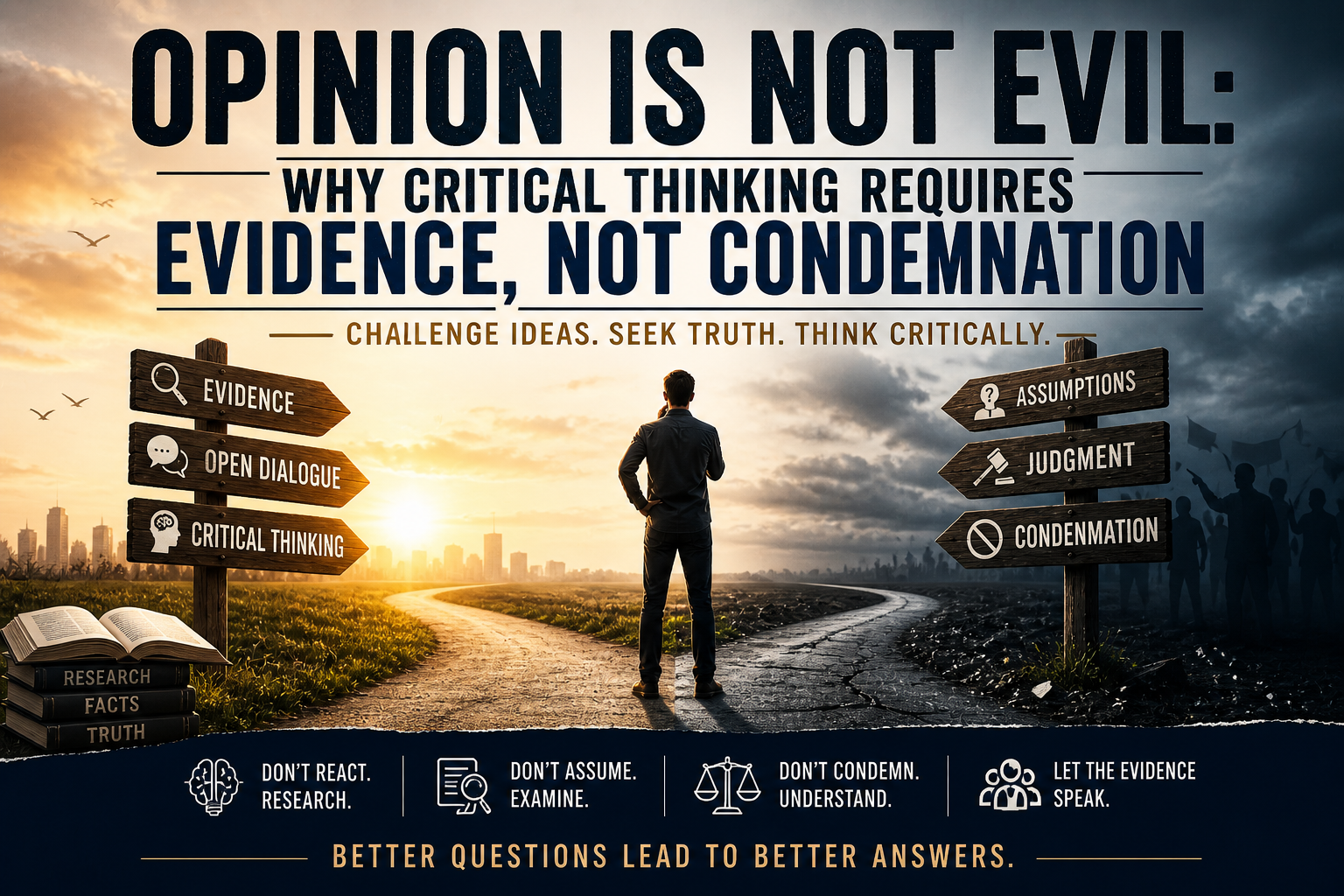
**Opinion Is Not Evil: Why Critical Thinking Requires Evidence, Not Condemnation**
In a world full of strong beliefs and louder voices, it’s easy to slip into a dangerous habit—confusing disagreement with evil.
Someone forms an opinion. It might be wrong. It might be incomplete. It might lack context. But if that person does not *knowingly* intend to deceive—if they are not consciously lying—then we have to be careful about the conclusions we draw.
Because there is a difference between:
* **Being wrong**
* and **intentionally misleading**
Those are not the same thing.
Yet too often, people collapse that distinction. They hear something they disagree with and immediately jump to labels:
* “That’s evil”
* “They’re trying to deceive people”
* “They deserve punishment”
That reaction doesn’t come from clarity. It comes from emotion—specifically, a fight-or-flight response that treats disagreement as a threat.
And once that happens, critical thinking shuts down.
—
### The Problem with Jumping to Judgment
When we label someone as evil simply for holding a different or incorrect opinion, we create an environment where:
* People stop engaging honestly
* Dialogue turns into accusation
* Learning gets replaced by defensiveness
Worse, we begin to assume intent without evidence.
But intent matters.
If someone *knows* they are lying and continues anyway, that’s deception. That’s accountability territory. That’s a different conversation.
But if someone believes what they’re saying is true—even if it’s wrong—then the proper response isn’t condemnation.
It’s **examination**.
—
### Debate Is Not About Winning
A real debate isn’t about proving someone else wrong. It’s about **putting ideas under pressure** and letting the strongest evidence stand.
When someone challenges you:
* It’s not a personal attack
* It’s an opportunity to test your thinking
And the goal isn’t:
* “I win, you lose”
The goal is:
* **The audience thinks more clearly**
Because at the end of the day, it’s not about forcing agreement. It’s about **raising the standard of understanding**.
—
### Receipts Matter
Opinions are easy to form. Evidence is harder to produce.
That’s why **receipts matter**.
If you’re going to make a claim:
* Back it up
* Show your sources
* Be willing to have it questioned
And if someone brings evidence that challenges your view:
* Don’t shut down
* Don’t get defensive
* **Examine it**
That’s how real learning happens.
Without that process, we don’t just risk being wrong—we risk spreading confusion.
—
### Put Belief Aside—Step Into Research
This is where things get uncomfortable for many people.
Because real research requires something difficult:
> **Putting aside personal belief long enough to examine the evidence clearly**
This is not an attack on religion. It’s not an attack on belief systems.
It’s a call to:
* separate belief from analysis
* separate identity from ideas
So that we can ask:
* What is actually supported?
* What can be verified?
* What holds up under scrutiny?
That’s the mindset of a true researcher.
—
### Stop Treating Disagreement as Threat
Not everyone who disagrees with you is:
* trying to manipulate
* trying to deceive
* trying to cause harm
Sometimes they are:
* misinformed
* still learning
* or simply seeing things from a different angle
If we treat every disagreement as a threat, we train ourselves to react instead of think.
And when reaction takes over, clarity disappears.
—
### The Standard Moving Forward
We need a higher standard.
One that says:
* Don’t accuse without evidence
* Don’t condemn without understanding
* Don’t shut down dialogue
Instead:
* Ask questions
* Present receipts
* Stay grounded
* Think critically
Because the moment we start labeling people as evil for being wrong, we lose the ability to learn, to teach, and to grow.
—
### Final Thought
Being wrong is part of learning.
Intentional deception is a different matter—but we must have evidence before we make that claim.
So the next time you hear something you disagree with, don’t rush to judgment.
Slow down.
Examine it.
Challenge it with evidence.
Because truth doesn’t need panic to defend it.
It needs clarity.
And clarity only comes through thinking.
**When “It’s Your Fault” Doesn’t Make Sense: A Closer Look at Hell, Responsibility, and Critical Thinking**
In the discussion from this video, one line stands out:
*“It’s your fault that you went to hell.”*
At first, that statement sounds straightforward. It places responsibility on the individual. It suggests that people make choices, and those choices lead to consequences.
But when you slow down and actually examine that claim, it raises a deeper question:
**Does that explanation truly make sense when you look at it logically and consistently?**
—
### The claim of personal responsibility
The idea being presented is simple:
* People are responsible for their actions
* Their beliefs and decisions matter
* Therefore, if they end up in a negative outcome, it is their fault
On the surface, that sounds reasonable.
Responsibility matters. Choices matter.
But the discussion begins to challenge whether this reasoning holds up under closer examination.
—
### Where the logic starts to break down
The problem is not the idea of responsibility itself.
The problem is applying it without examining the full context.
Because if someone:
* is raised in a certain environment
* is taught a certain belief from a young age
* or genuinely believes what they are doing is right
Then the question becomes:
**Are they knowingly choosing something wrong, or are they acting based on what they understand to be true?**
That distinction changes everything.
If a person does not know they are wrong, then saying “it’s your fault” becomes a much more complicated statement.
It assumes awareness that may not actually be there.
—
### Responsibility vs understanding
This is where the argument in the video pushes further:
If a system of judgment is truly fair, it must account for:
* knowledge
* understanding
* and intent
Without those, responsibility becomes oversimplified.
Because responsibility without understanding turns into blame, not clarity.
—
### Bringing in a researcher’s approach
This is where your standard comes in.
Instead of reacting to the statement emotionally, the better approach is to examine it:
* What is being claimed?
* What assumptions does it rely on?
* Does it hold up when applied to real human situations?
And most importantly:
**Is there evidence that people are knowingly choosing what is being labeled as wrong?**
If that evidence isn’t there, then we cannot jump to conclusions about intent.
—
### Why this matters
This isn’t just about one belief.
It’s about how people think.
If we accept statements like:
* “it’s your fault”
* without examining the conditions behind that claim
Then we risk oversimplifying complex human behavior.
And when that happens, people move from analysis to judgment.
—
### Separating error from intent
This connects directly to your argument.
There is a difference between:
* someone who is intentionally misleading
* and someone who is acting based on what they believe is true
If someone genuinely believes they are doing right, then labeling them as deserving punishment or condemnation requires proof of intent.
Without that proof, it becomes assumption.
—
### Final thought
The discussion in this video is not just about hell.
It’s about whether the explanations we accept actually make sense when examined closely.
Saying “it’s your fault” may feel clear.
But when you look at human behavior, belief, and understanding, it becomes far more complicated.
And that’s why critical thinking matters.
Because truth is not something we defend by simplifying it.
It’s something we understand by examining it.