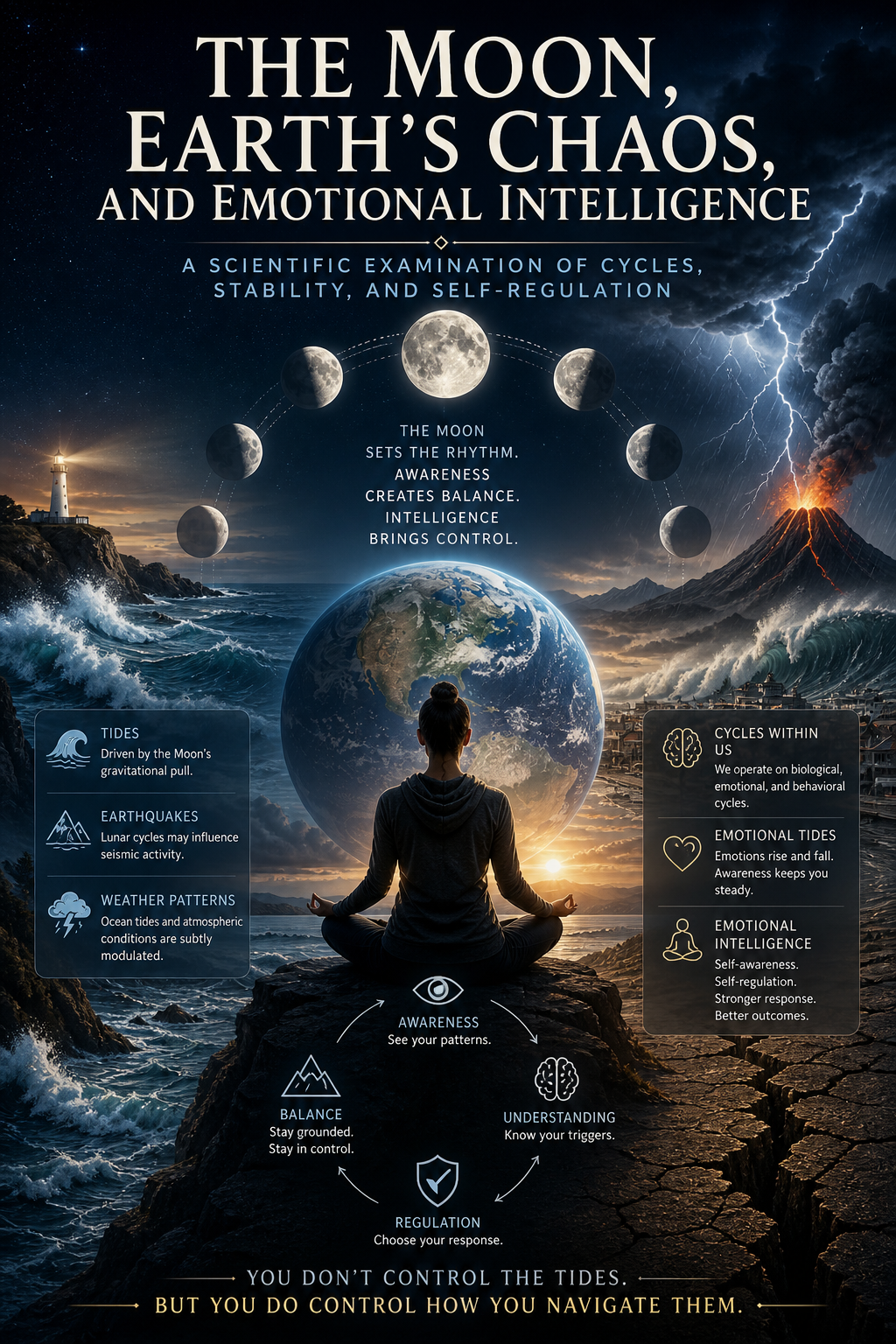
The Moon, Earth’s Chaos, and Emotional Intelligence
A Scientific Examination of Cycles, Stability, and Self-Regulation
1. The Moon as a Physical Regulator of Earth Systems
From a strictly scientific standpoint, the Moon is not symbolic—it is mechanistically influential. Its gravitational pull directly affects Earth’s oceans, crust, and even subtle atmospheric dynamics.
- The most well-documented effect is tides, driven by gravitational interaction between Earth and the Moon.
- This interaction is governed by orbital mechanics studied extensively by NASA.
- The Moon stabilizes Earth’s axial tilt (obliquity), which prevents extreme climate swings.
Without the Moon:
- Earth’s tilt could vary dramatically
- Climate would become far more chaotic over time
- Seasonal predictability would degrade
Key takeaway: The Moon acts as a stabilizer within a dynamic system, not a cause of chaos—but a regulator of it.
2. Moon Cycles: What Actually Changes?
The Moon cycles through phases roughly every 29.5 days (lunar cycle):
- New Moon
- First Quarter
- Full Moon
- Last Quarter
These phases reflect changing illumination—not changes in gravitational strength (which remains relatively constant).
However, there are measurable cyclical effects:
A. Tidal Extremes
- Spring tides (New/Full Moon): stronger tides
- Neap tides (Quarter phases): weaker tides
These can:
- Influence coastal flooding
- Affect ocean currents
- Slightly alter pressure systems
B. Geological Effects
There is ongoing research into whether lunar cycles influence:
- Earthquake frequency
- Volcanic activity
Some studies suggest:
- A slight statistical increase in seismic activity during full/new moons due to tidal stress on Earth’s crust
- But this effect is weak and not deterministic
C. Weather Patterns
The Moon does not directly cause storms or hurricanes, but it can:
- Modulate ocean tides → affects coastal storm impact
- Influence atmospheric tides (very subtle)
Conclusion:
The Moon contributes to cyclical pressure and rhythm, not random chaos.
3. Chaos on Earth: Where It Really Comes From
Events like:
- Tsunamis
- Earthquakes
- Hurricanes
- Climate variability
are primarily driven by:
- Plate tectonics (Earth’s internal heat and movement)
- Solar energy input
- Ocean-atmosphere interactions
- Chaotic systems behavior (nonlinear dynamics)
Relevant scientific framework:
- Chaos Theory
Chaos Theory shows:
- Small inputs → large outcomes (butterfly effect)
- Systems are patterned but unpredictable
Important distinction:
- The Moon = cyclical influence
- Earth systems = complex, multi-variable chaos
4. Emotional Intelligence: The Human Parallel
Now we transition from physics → psychology.
Emotional intelligence (EI) is studied in psychology and neuroscience as:
- Self-awareness
- Self-regulation
- Pattern recognition in behavior
Popularized in modern research by figures like:
- Daniel Goleman
5. Human Cycles Are Real (But Not Mystical)
Humans operate on biological cycles:
A. Circadian Rhythms
- 24-hour cycles tied to light/dark
- Govern sleep, hormones, cognition
B. Hormonal Cycles
- Cortisol (stress)
- Melatonin (sleep)
- Dopamine/serotonin (mood)
C. Behavioral Cycles
- Habits
- Emotional triggers
- Stress-response loops
This is where the real connection exists:
- Not “the Moon controls your emotions”
- But humans are cyclical systems embedded in a cyclical environment
6. The Practical Bridge: From Moon Cycles → Emotional Intelligence
The Moon provides a model of rhythm, not a controller of your emotions.
You can apply this scientifically:
Step 1: Identify Your Emotional Cycles
Track:
- When you feel stressed
- When you feel clear-headed
- When you react impulsively
You will find:
- Patterns tied to sleep, stress, environment—not lunar phases directly
Step 2: Recognize “Emotional Tides”
Just like oceans:
- Emotions rise (intensity)
- Emotions fall (recovery)
Without awareness:
- You interpret intensity as truth
With awareness: - You recognize it as temporary state
Step 3: Build Regulation Systems
- Sleep discipline (aligns circadian rhythm)
- Breath control (affects nervous system)
- Cognitive reframing (prefrontal cortex engagement)
Step 4: Interrupt Chaos Loops
- Small trigger → big reaction
- Feedback loop → escalation
Emotional intelligence allows you to:
- Break the loop early
- Reduce amplification
7. “Receipts”: What Science Actually Supports
Supported by evidence:
- The Moon affects tides ✔
- The Moon stabilizes Earth’s tilt ✔
- Humans operate on biological cycles ✔
- Emotional regulation can be trained ✔
Weak or limited evidence:
- Moon phases directly controlling human behavior ❗
- Strong causal link between lunar cycles and earthquakes ❗
8. What This Reveals (Without Overreach)
From a scientific lens:
- Systems—whether planetary or psychological—operate on cycles + feedback loops
- Stability comes from regulation, not elimination of fluctuation
- Chaos is not random—it is structured unpredictability
Translation to emotional intelligence:
- You will have emotional “storms”
- You cannot eliminate them
- But you can:
- Predict patterns
- Reduce intensity
- Recover faster
9. Final Position: Precision Over Myth
- The Moon is a rhythmic stabilizer, not an emotional controller
- Earth’s chaos comes from complex systems, not lunar mood swings
- Emotional intelligence is about self-regulation within cycles, not escaping them
Bottom Line
You don’t control the tides.
But you do control how you navigate them.
That’s the real intersection between:
- The Moon
- Earth’s systems
- And your emotional intelligence
Why I Made “When All Hell Breaks Loose”
Connecting Chaos, Cycles, and Emotional Mastery
This song didn’t come from nowhere.
It came from observation—real observation.
After breaking down The Moon, Earth’s Chaos, and Emotional Intelligence, something became clear to me:
The world runs on cycles.
But so do we.
And most people?
They don’t even realize they’re trapped inside them.
The Realization That Sparked the Song
When I looked at how the Moon influences tides, how Earth operates through pressure systems, and how chaos forms through complex interactions, I saw something deeper:
- The ocean doesn’t panic when tides rise
- The planet doesn’t “lose control” during storms
- These systems move through cycles—intense, yes—but structured
Then I looked at people.
And that’s where it got uncomfortable.
Because unlike the Earth…
we react to our cycles instead of understanding them.
The Pattern Problem
What I kept seeing—over and over again—was this:
- People get triggered
- Emotions spike
- Reactions follow
- Regret comes after
And then?
It repeats.
Same emotional loop.
Different day.
Different excuse.
That’s not chaos.
That’s a pattern pretending to be chaos.
And that’s exactly what this song calls out.
Why the Song Is Sarcastic
The sarcasm in When All Hell Breaks Loose isn’t random—it’s intentional.
Because sometimes the truth hits harder when it exposes the contradiction:
- “This time is different” — but it never is
- “I didn’t see it coming” — but it always comes the same way
- “I couldn’t control it” — but the reaction was predictable
The sarcasm is there to break denial.
Not to tear people down—
but to wake them up.
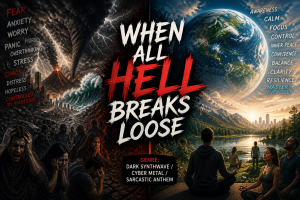
The Two Worlds in the Thumbnail
The visual concept you created—the chaos vs. calm—isn’t just aesthetic.
It’s psychological.
Left side:
- Fear
- Anxiety
- Overreaction
- External chaos controlling internal state
Right side:
- Awareness
- Regulation
- Control
- Internal stability regardless of external conditions
That’s the entire message of both the article and the song:
The world can be chaotic…
but you don’t have to be.
The Scientific Backbone Behind the Message
This isn’t just philosophy—it’s grounded in reality.
From the original article:
- The Moon creates rhythms, not emotional instability
- Earth operates through structured chaos, not randomness
- Humans function through biological and behavioral cycles
So if:
- Nature can operate in cycles without “losing control”
- Systems can remain stable inside chaos
Then the real question becomes:
Why don’t we?
Emotional Intelligence Is the Missing Link
This is where emotional intelligence comes in.
The song isn’t just asking a question—it’s forcing a confrontation:
When the cycle shows up…
what are you going to do?
Because that moment—that split second—is everything.
- That’s where patterns repeat
- That’s where reactions take over
- That’s where people give up control
Or…
That’s where awareness steps in.
Breaking the Cycle vs. Feeding It
Most people think chaos is the enemy.
It’s not.
The real problem is:
- Unconscious reaction
- Emotional autopilot
- Lack of self-awareness
Chaos exposes your patterns.
It doesn’t create them.
That’s why the song hits the way it does.
It’s not attacking the storm—
it’s exposing how you respond to it.
Why This Matters
Because if you don’t understand your cycles:
- You’ll keep calling patterns “bad luck”
- You’ll keep calling reactions “who you are”
- You’ll keep living in emotional loops
But once you see it?
You can’t unsee it.
And that’s where everything changes.
The Core Message
This song, combined with the article, is saying one thing—clearly:
- The Moon has cycles
- The Earth has cycles
- You have cycles
The difference is:
You have the ability to become aware of yours.
Final Thought
When all hell breaks loose…
that’s not the moment you lose control.
That’s the moment you find out if you ever had it.
So the question isn’t about the world.
It’s about you.
Are you going to repeat the pattern…
or are you finally going to break it?